
ALDEA GLOBAL

Si se trata de resguardar nuestros ahorros, la recomendación es recurrir a “valores refugio”, porque lo de meterlos bajo el colchón o enterrarlos en una vasija al pie de la higuera es una práctica nada recomendable. Y el valor que tradicionalmente viene siendo el asidero al que encomendarse cuando vienen mal dadas es el oro. Con luces, pero también con sombras, como que su cotización es especulativa y no es un dinero que dé intereses. Aun así, llegados a la mitad de 2026, en el mundo económico y financiero son mayoría quienes creen que sigue siendo lo más seguro, como reza el dicho que nos sirve de titular. Cabe advertir, eso sí, que cualquier opinión puede quedar desactualizada en minutos si las circunstancias geopolíticas, geoestratégicas y, sobre todo, bélicas cambian bruscamente.
El oro, solo por recordarlo, va más allá de sus usos en joyería, de los que todos tenemos referencias, o de su historia en la fabricación de monedas. Es un metal básico en tecnología porque tiene un alto grado de conductividad y de resistencia a la corrosión, así que es de vital importancia para equipos desde teléfonos móviles y ordenadores, hasta naves espaciales. Y también es indispensable en medicina por su biocompatibilidad, además de usarse en nanotecnología para el diagnóstico de enfermedades. Pero el oro, una pena, no se puede fabricar y es cada vez más escaso, aunque ya hay planes para buscarlo en planetas cercanos. Es esa escasez, precisamente, la que le confiere su valor económico.
DIEZ DÍAS ANTES DE LA INVASIÓN DE UCRANIA, SUCEDIDA EL 28 DE FEBRERO DE 2024, EL ORO SUPERO LOS 2.000 $/OZ, VALOR DEL QUE NO HA VUELTO A APEARSE
Oro y crisis
Una manera de visualizar cómo el oro ha concitado el interés de los inversores cuando vienen mal dadas es repasar nuestra historia económica reciente, entendiendo por tal los últimos sesenta años. Y permítannos que utilicemos unidades internacionales para las comparativas, porque las conversiones a moneda actual serían irreales. Dichas unidades son el dólar por onza, siendo ésta la “apellidada” troy, cuyo peso equivale a 31,1035 gramos (importante no confundirla con la onza estándar o avoirdupois, que pesa 28,35 gramos).
Hechas las aclaraciones, recordemos que durante la ‘crisis del petróleo de los 70’, cuando los países productores (la OPEC) establecieron un embargo internacional de ese otro oro, el negro, el dorado paso de los 35 dólares la onza a los 200. Al final de esa década, con la ‘crisis de los rehenes’, tras la toma por un grupo de estudiantes islámicos de la embajada de EE.UU. en Teherán, la onza alcanzó los 850 dólares. Llegados al siglo XXI, con la caída de Lehman Brothers y la llegada de la ‘crisis financiera de 2008’, el valor oro creció exponencialmente hasta los 1.900 dólares la onza. Ese valor, por encima de los 2.000 dólares, se superó a causa de la ‘crisis de la pandemia del COVID-19’.
EL ORO ES INDISPENSABLE EN MEDICINA POR SU BIOCOMPATIBILIDAD, ADEMÁS DE USARSE EN NANOTECNOLOGÍA PARA EL DIAGNÓSTICO DE ENFERMEDADES
Valor actual
Webs como Inversoro.es ofrecen la posibilidad de ver gráficamente la evolución del precio del oro según el periodo que seleccionemos. En nuestro caso, hemos buscado la cotización en los últimos cinco años, partiendo de un valor de 1.832 dólares la onza a mitad de julio de 2021. El precio se fue manteniendo, con una bajada puntual en septiembre de 2022 hasta los 1.634 dólares, seguramente a causa de la política monetaria de la Reserva Federal de EE.UU. (FED). Desde ahí, fue recuperándose paulatinamente hasta diez días antes de la invasión de Ucrania, sucedida el 28 de febrero de 2024, en que supero los 2.000 dólares, valor del que no ha vuelto a apearse. Pasó de los 2.500 en agosto de 2024 y de los 3.000 en marzo de 2025. La escalada se debe, básicamente, a las políticas arancelarias del actual inquilino de la Casa Blanca y a sus vaivenes geopolíticos.
Así llegamos al 21 de agosto de 2025, en que la cotización estaba en 3.338 dólares, en un momento en que se da una combinación de turbulencias geopolíticas (Ucrania, amenazas sobre Groenlandia, Gaza, Irán), la incertidumbre por la imposición de nuevos aranceles comerciales y las expectativas del mercado de una pronta bajada de los tipos de interés por parte de la FED. Recordemos que hablamos de un valor refugio… Desde ahí, escalada vertiginosa hasta visualizar todo un ‘Everest’ en la gráfica de 5.635 dólares el pasado 29 de enero, intuyendo lo que vendría un mes más tarde con el ataque a Irán. A partir de ese momento, altibajos, descensos leves y tendencia a la baja a partir de mayo, pero siempre con valores en torno a los 4.000 dólares la onza.
SEGÚN WORLD GOLD COUNCIL, “LAS RESERVAS MUNDIALES DE ORO DE LOS BANCOS CENTRALES AUMENTARÁN EN LOS PRÓXIMOS DOCE MESES”
¿Refugio dorado?
Ya saben, en fin, que el dinero es miedoso e intenta ir “a lo seguro” o, dicho de otra manera, a lo que se sabe que va bien. Este debe ser el criterio de los bancos centrales. Según la última encuesta del World Gold Council, publicada a mediados de junio de 2026 con datos de 76 bancos centrales, estos “han acumulado un promedio de 1.000 toneladas de oro en los últimos cuatro años, un aumento significativo con respecto al promedio de 500 toneladas de la década anterior”. Y añaden: “La gran mayoría de los encuestados, un 89%, cree que las reservas mundiales de oro de los bancos centrales aumentarán en los próximos doce meses”. Es decir: para estas entidades, el oro sí es un valor refugio, dado que están dispuestas a seguir comprando. Un dato más: el Deutsche Bank Research Institute, en el estudio The return of history: gold, the dollar, and the monetary future (abril de 2026), concluye que China, Rusia, la India y Turquía están aumentando sus reservas áureas; y en sus proyecciones aventura un valor de 8.000 dólares la onza en menos de un lustro.
CASI LA MITAD DE LOS GRANDES TENEDORES GUARDAN EL ORO EN SU PROPIO TERRITORIO Y PARA LOS QUE LO DEPOSITAN EN OTRO “LUGAR SEGURO”, EL BANCO DE INGLATERRA ES EL PRINCIPAL CUSTODIO
Sin embargo, no están tan seguros de la calidad del oro como refugio economistas como Frank Schallenberger, experto en investigación macroeconómica del Landesbank Baden-Württemberg, LBBW (los landersbank son un grupo de bancos gestores de las cajas de ahorro alemanas), quien en declaraciones a la emisora de radio pública Deutsche Welle ha explicado que no es buena idea mantener la inversión en oro a gran escala; si acaso entre un cinco y un diez por ciento de la cartera “como medida de protección”. Traducido al román paladino, el oro es valor refugio, pero sólo un poco. Esto, aunque el propio Schallenberger, en sus proyecciones para 2026, dijera que “la demanda de oro seguirá siendo alta en 2026, ya que la incertidumbre política mantendrá el atractivo de este activo refugio”. Y eso que aún no se había producido la escalada de EE.UU. en Irán cuando escribió esas predicciones.
Hablando de incertidumbres
En el informe que antes citábamos del World Gold Council, se considera que el precio del oro al final del primer semestre de 2026, esos 4.000 dólares la onza troy, va a mantenerse con una variación de +/-5% durante el segundo semestre, pero, ojo, si las circunstancias no dan un vuelco drástico. Claro que la estabilidad es cosa complicada, añadimos de nuestra cosecha, con el panorama que tenemos en Ormuz. La posibilidad de un deterioro económico nos acecha cual espada de Damocles y este sería el principal factor de influencia en la demanda y el precio del oro, sobre todo porque estaría condicionando las políticas de los tipos de interés de los principales bancos centrales.
WEBS COMO INVERSORO.ES OFRECEN LA POSIBILIDAD DE VER GRÁFICAMENTE LA EVOLUCIÓN DEL PRECIO DEL ORO SEGÚN EL PERIODO QUE SELECCIONEMOS
Como ya comentamos, son los bancos centrales los mayores compradores de oro. Y si alguien se pregunta cómo se aseguran de que a su dorado metal no le va a pasar nada o, dicho de otra forma, que estará disponible donde lo hayan guardado, aquí va otro dato más de la encuesta: casi la mitad de estos grandes tenedores guardan el oro en su propio territorio y para los que lo depositan en otro “lugar seguro”, el Banco de Inglaterra es el principal custodio del metal con el 57% de las preferencias, el Banco Internacional de Pagos (el llamado “banco de los bancos centrales”) es utilizado por el 16% y el Banco Nacional de Suiza ya sólo es preferido solo por el 6% de las instituciones. Detalle: EE.UU., con todo su famoso Fort Knox, ha dejado de ser el lugar favorito de los bancos para salvaguardar su oro. Y como “no es oro todo lo que reluce” –nos lo ha puesto fácil el dicho, cierto–, un apunte final: tres cuartas partes de los bancos centrales prevén reducir sus reservas de dólares en los próximos años. Buena noticia para quienes creen que la dependencia financiera del país americano y su moneda no es actualmente un buen negocio.
Los que más oro acumulan
El listado de países e instituciones con más reservas de oro, con datos del primer trimestre de 2026, lo encabezan Estados Unidos, con 8.133 toneladas; Alemania, con 3.351 toneladas (los alemanes han repatriado el oro que tenían depositado en EE.UU.); Italia, con 2.452 toneladas; Francia, con 2.437 toneladas; China, con 2.313 toneladas; Rusia con 2.305 toneladas y Suiza, con 1.040 toneladas.
España tiene unas reservas de oro de unas 282 toneladas (número 20 en el listado), un 46% menos que en 2004, que permanecen estables desde 2007. Esas 282 Tm equivalen a 9.066.510,77 onzas troy. Si calculamos su valor al final de primer semestre de 2026, a unos 3.500 euros la onza, las reservas suponen 31.733 millones de euros.
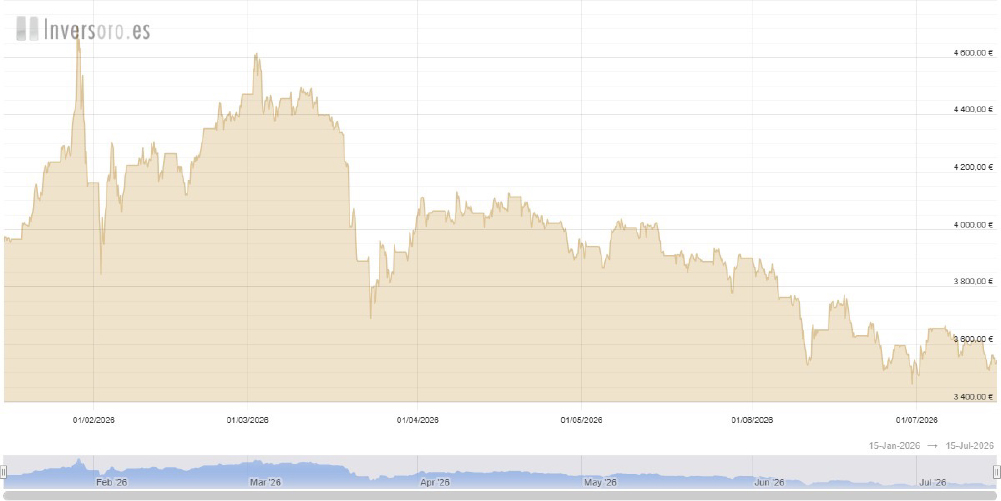
El precio del oro en el primer semestre 2026
El último día de junio de 2026, el precio del oro rondaba su cotización más baja, en torno a los 3.500 euros la onza troy. Su valor máximo fue el 29 de enero, con 4.652,5 euros la onza. Esto da una idea de las fluctuaciones del precio del oro según los vaivenes macroeconómicos y geoestratégicos.
Para saber más
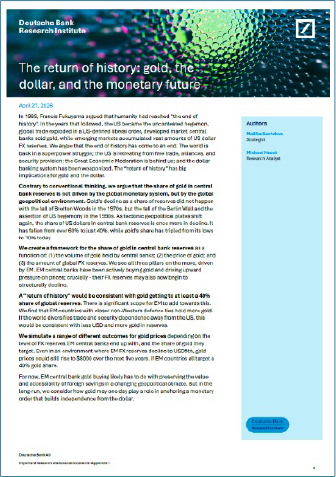 The return of history: gold, the dollar, and the monetary future.
Deutsche Bank Research Institute (abril de 2026).
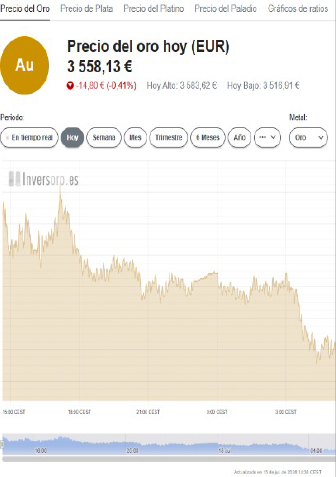 Cotización del oro en tiempo real.
Inversoro.es
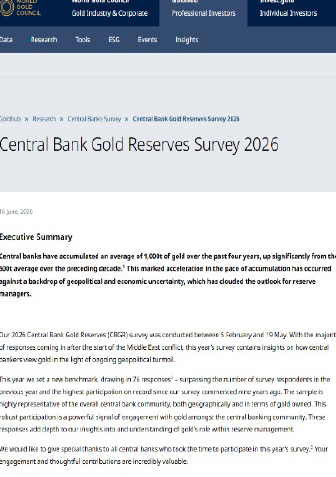 Central Bank Gold Reserves Survey 2026.
World Gold Council (junio de 2026).
GLOBAL VILLAGE
When it comes to safeguarding our savings, the advice is to turn to ‘safe-haven assets’, because stashing them under the mattress or burying them in a pot at the foot of the fig tree is a practice that is by no means advisable. And the resource that has traditionally been the material to rely on when things go wrong is gold. It has its pros and cons – for instance, its price is subject to speculation and it doesn’t earn interest. Even so, by mid-2026, the majority in economic and financial circles believe that it remains the safest option, as the saying that serves as our headline puts it. It should be noted, however, that any opinion may become outdated within minutes if geopolitical, geostrategic and, above all, military circumstances change abruptly.
Gold, just to remind you, has uses that go beyond jewellery – which we are all familiar with – or its history in coin-making. It is a key metal in technology because it has a high degree of conductivity and corrosion resistance, making it vitally important for equipment ranging from mobile phones and computers to spacecraft. It is also indispensable in medicine due to its biocompatibility. It is also used in nanotechnology for the diagnosis of diseases. But gold, unfortunately, cannot be manufactured and is becoming increasingly scarce, although there are already plans to search for it on nearby planets. It is precisely this scarcity that gives it its economic value.
Gold and the crisis
One way to see how gold has attracted investors’ interest when times are hard is to look back at our recent economic history – by which I mean the last sixty years. And please allow us to use international units for the comparisons, as conversions to current currency would be unrealistic. These units are the dollar per ounce, the so-called ‘troy’ ounce, which weighs 31.1035 grams (it is important not to confuse this with the standard ounce or avoirdupois, which weighs 28.35 grams).
TEN DAYS BEFORE THE INVASION OF UKRAINE, WHICH TOOK PLACE ON 28 FEBRUARY 2024, THE PRICE OF GOLD ROSE ABOVE $2,000 PER OUNCE, A LEVEL IT HAS NOT FALLEN BELOW SINCE
Having clarified these points, let us recall that during the ‘oil crisis of the 1970s’, when the oil-producing countries (OPEC) imposed an international embargo on that other ‘gold’ – black gold – the price of gold rose from 35 dollars an ounce to 200. Towards the end of that decade, during the ‘hostage crisis’ following the seizure of the US embassy in Tehran by a group of Islamic students, the price of an ounce reached $850. By the 21st century, following the collapse of Lehman Brothers and the onset of the ‘2008 financial crisis’, the price of gold rose exponentially to $1,900 an ounce. That figure, which stood at over $2,000, was exceeded as a result of the ‘COVID-19 pandemic crisis’.
Current value
Websites such as Inversoro.es allow you to view a graph showing the trend in the price of gold over the period of your choice. In our case, we have looked at the price over the last five years, taking as our starting point a price of $1,832 per ounce in mid-July 2021. The price remained stable, with a one-off fall in September 2022 to $1,634, most likely due to the US Federal Reserve’s monetary policy. (FED). From then on, it gradually recovered until ten days before the invasion of Ukraine, which took place on 28 February 2024, when it rose above $2,000 – a level it has not fallen below since. It exceeded 2,500 in August 2024 and 3,000 in March 2025. The escalation is essentially due to the tariff policies of the current occupant of the White House and his geopolitical manoeuvring.
GOLD IS INDISPENSABLE IN MEDICINE DUE TO ITS BIOCOMPATIBILITY, AND IS ALSO USED IN NANOTECHNOLOGY FOR THE DIAGNOSIS OF DISEASES
This brings us to 21 August 2025, when the share price stood at $3,338, at a time marked by a combination of geopolitical turmoil (Ukraine, threats regarding Greenland, Gaza, Iran), uncertainty over the imposition of new trade tariffs, and market expectations of an imminent cut in interest rates by the Fed. Let’s remember that we’re talking about a safe-haven asset… From there, it rose vertiginously until it reached an ‘Everest’-like peak of $5,635 on the chart on 29 January, foreshadowing what was to come a month later with the attack on Iran. From that point, there were ups and downs, slight falls and a downward trend from May onwards, but prices always hovered around $4,000 an ounce.
ACCORDING TO THE WORLD GOLD COUNCIL, “GLOBAL CENTRAL BANK GOLD RESERVES ARE SET TO RISE OVER THE NEXT TWELVE MONTHS”
A golden refuge?
As you know, money is timid and tends to play it ‘safe’ – or, to put it another way, to go for what is known to work. This should be the criterion adopted by central banks. According to the latest survey by the World Gold Council, published in mid-June 2026 and based on data from 76 central banks, they “have accumulated an average of 1,000 tonnes of gold over the last four years, a significant increase on the average of 500 tonnes over the previous decade”. And they add: “The vast majority of respondents – 89 per cent – believe that central banks’ global gold reserves will increase over the next twelve months”. In other words: for these institutions, gold is indeed a safe-haven asset, given that they are prepared to continue buying it. One more point: the Deutsche Bank Research Institute, in its study The return of history: gold, the dollar, and the monetary future (April 2026), concludes that China, Russia, India and Turkey are increasing their gold reserves; and in its projections, it forecasts a price of $8,000 per ounce within less than five years.
However, economists such as Frank Schallenberger, an expert in macroeconomic research at Landesbank Baden-Württemberg, LBBW (the Landesbanks are a group of banks that manage German savings banks), who, speaking to the public radio station Deutsche Welle, explained that it is not a good idea to hold large-scale investments in gold; if anything, between five and ten per cent of the portfolio “as a safeguard”. Put simply, gold is a safe-haven asset, but only to a limited extent. This is despite the fact that Schallenberger himself, in his forecasts for 2026, stated that “demand for gold will remain high in 2026, as political uncertainty will maintain the appeal of this safe-haven asset”. And that was even before the US escalation in Iran had taken place when he wrote those predictions.
ALMOST HALF OF THE MAJOR HOLDERS KEEP THEIR GOLD WITHIN THEIR OWN COUNTRY, AND FOR THOSE WHO DEPOSIT IT IN ANOTHER ‘SAFE HAVEN’, THE BANK OF
Speaking of uncertainties
In the report referred to earlier from the World Gold Council, it is estimated that the price of gold at the end of the first half of 2026 – that is, $4,000 per troy ounce – will remain within a range of +/-5 per cent during the second half of the year, but, mind you, that is provided circumstances do not take a drastic turn. Of course, it should be added that stability is a complicated thing, given the situation we have in Hormuz. The prospect of an economic downturn hangs over us like the sword of Damocles, and this would be the main factor influencing demand for and the price of gold, particularly as it would be shaping the interest rate policies of the major central banks.
ENGLAND IS THE MAIN CUSTODIAN.
WEBSITES SUCH AS INVERSORO.ES ALLOW YOU TO VIEW A GRAPH SHOWING THE TREND IN THE PRICE OF GOLD OVER THE PERIOD OF YOUR CHOICE
As we have already mentioned, central banks are the largest buyers of gold. And if anyone is wondering how they ensure that nothing will happen to their precious metal – or, to put it another way, that it will be available wherever they have stored it – here is another finding from the survey: almost half of these major holders store their gold within their own country, and for those who deposit it in another ‘safe haven’, the Bank of England is the main custodian of the metal, accounting for 57 per cent of preferences; the Bank for International Settlements (the so-called ‘bank of central banks’) is used by 16 per cent; and the Swiss National Bank is now preferred by only 6 per cent of institutions. List: The US, with its famous Fort Knox, is no longer the banks’ favourite place to store their gold. And as ‘all that glitters is not gold’ – the saying certainly makes it easy for us – here’s a final point: three-quarters of central banks plan to reduce their dollar reserves in the coming years. Good news for those who believe that financial dependence on the US and its currency is not currently a sound investment.
Those who hoard the most gold
The list of countries and institutions with the largest gold reserves, based on data from the first quarter of 2026, is headed by the United States, with 8,133 tonnes; Germany, with 3,351 tonnes (the Germans have repatriated the gold they had deposited in the US); Italy, with 2,452 tonnes; France, with 2,437 tonnes; China, with 2,313 tonnes; Russia, with 2,305 tonnes; and Switzerland, with 1,040 tonnes.
Spain has gold reserves of around 282 tonnes (ranked 20th on the list), 46 per cent less than in 2004, and these have remained stable since 2007. Those 282 metric tonnes are equivalent to 9,066,510.77 troy ounces. If we calculate their value at the end of the first half of 2026, at around 3,500 euros per ounce, the reserves amount to 31,733 million euros.
The price of gold in the first half of 2026
On the last day of June 2026, the price of gold was hovering around its lowest level, at around 3,500 euros per troy ounce. It reached its highest level on 29 January, at 4,652.5 euros per ounce. This gives an idea of how the price of gold fluctuates in line with macroeconomic and geostrategic developments.
Find out more
The Return of History: Gold, the Dollar and the Monetary Future.
Deutsche Bank Research Institute (April 2026).
Real-time gold prices.
Inversoro.es
Central Bank Gold Reserves Survey 2026.
World Gold Council (June 2026).